If your factory’s electricity bill shows a power factor penalty, or your transformer runs hot even when the load seems normal, a PFI plant may be the answer. This guide explains power factor in simple terms and how a PFI plant improves it.
What is power factor?
Motors, transformers and many machines need two kinds of power: real power (kW), which does useful work, and reactive power (kVAR), which builds the magnetic fields they need to run. Power factor is the ratio of real power to the total apparent power (kVA).
As our ebook puts it, the power factor of a system is degraded by the inductive load of industries and big apartments. A power factor of 1.0 is perfect. Many factories without correction run at 0.7 to 0.8.
Why low power factor costs you money
- Utility penalties. Utilities in Bangladesh charge industrial consumers extra when their power factor falls below the level set in the tariff. Check the power factor line on your bill.
- Higher current. At low power factor the same kW needs more current, so cables, breakers and the transformer run hotter.
- Less spare capacity. Your transformer’s kVA is used up by reactive power instead of useful load.
- Voltage drop. Higher current means more voltage drop at the end of long feeders.
How a PFI plant works
A PFI (Power Factor Improvement) plant is a panel with banks of capacitors that supply reactive power locally, so it does not have to come from the utility. An automatic power factor relay measures the power factor continuously and switches capacitor steps in and out through contactors as the load changes.
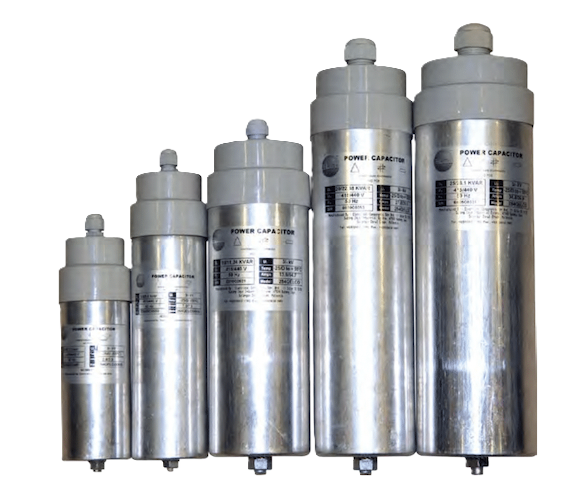
A good PFI plant includes:
- capacitor banks in steps (for example 25 or 50 kVAR each)
- capacitor-duty magnetic contactors
- an automatic power factor relay
- MCCB or fuse protection for each step
- detuned reactors where drives and VFDs create harmonics
- ventilation fans, because capacitors last longer when kept cool
How to size a PFI plant (kVAR)
The capacitor rating you need is:
kVAR = kW × (tan φ1 − tan φ2)
where φ1 is the angle at your present power factor and φ2 is the angle at your target. For example, to raise a 500 kW load from 0.80 to 0.97:
- tan φ1 at 0.80 = 0.75
- tan φ2 at 0.97 = 0.25
- kVAR = 500 × (0.75 − 0.25) = about 250 kVAR
In practice, our engineers check your bills or take readings on site and add some margin for future load.
Where to install it
Most factories install the PFI plant next to the LT panel, fed from its own breaker. Large motors can also have fixed capacitors at the motor control panel.
Frequently asked questions
How quickly does a PFI plant pay for itself?
If you are paying power factor penalties, the savings on the bill often cover the cost of the plant quickly. The reduced current also extends the life of cables and transformers.
Do capacitors need maintenance?
Yes. Capacitors lose capacity over time. Checking the kVAR of each step once or twice a year keeps the plant working well.
Get a PFI plant quotation
Send us a recent electricity bill or your load details. We will size the right PFI plant and supply a panel built at our Dhaka factory. See our PFI panel and capacitor bank pages, or request a quotation.
বাংলায় পড়ুন: পিএফআই প্ল্যান্ট: পাওয়ার ফ্যাক্টর বাড়িয়ে বিদ্যুৎ বিল কমানোর উপায়