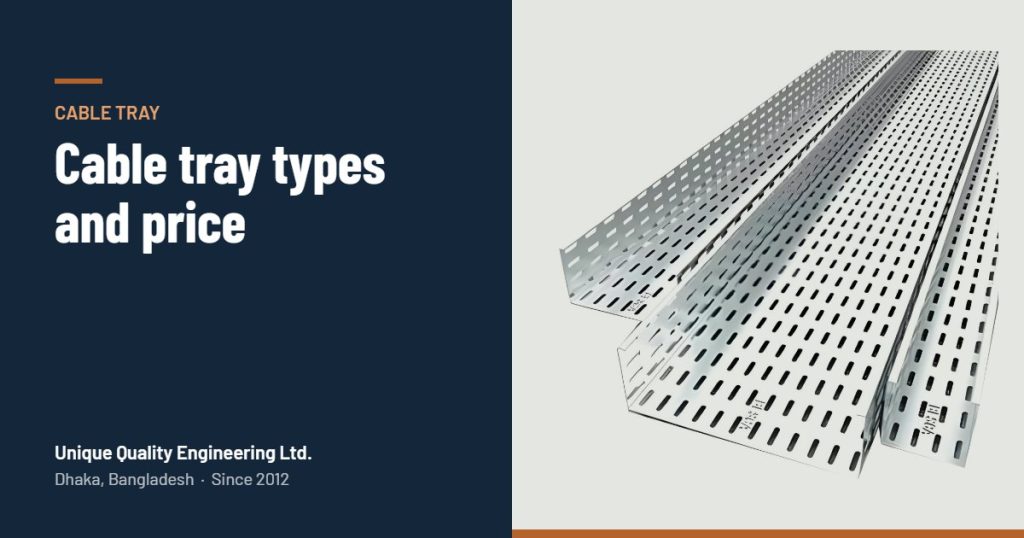
Every electrical installation needs a safe, organised route for its cables. Cable trays provide that route. Choosing the right type of tray makes installation faster, keeps cables cool and makes future changes easier. Here is a practical guide to the main cable tray types used in Bangladesh.
What is a cable tray?
Our ebook defines cable trays as mechanical support systems that provide a rigid structural system for electrical cables, raceways and insulated conductors used for power distribution, control, signal instrumentation and communication. Metal cable trays are made of galvanised steel, stainless steel and aluminium.
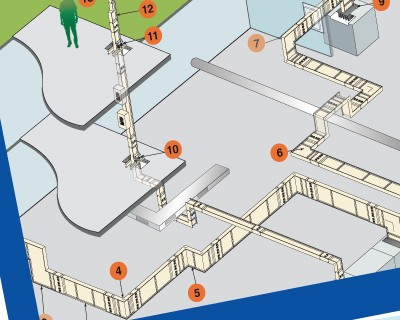
Six types of cable tray
1. Perforated cable tray
The most common type. The perforated base supports cables well and lets heat escape. Ideal for power and control cables in factories and buildings. See perforated cable tray.
2. Ladder type cable tray (cable ladder)
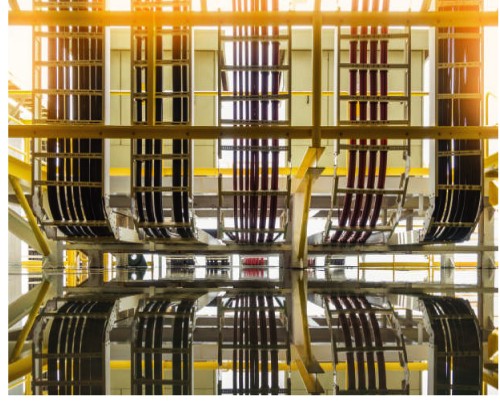
Two side rails joined by rungs. Ladders carry heavy power cables over long spans with excellent ventilation, and cables can leave the tray at any point. See ladder type cable tray.
3. Solid bottom cable tray
A closed base protects sensitive cables from dust, dripping water and electrical interference. Used for instrumentation, data and control cables. See solid bottom cable tray.
4. Wire mesh (basket) cable tray
A light welded wire basket that is easy to cut and bend on site. Popular for data, CCTV and low-voltage cables in offices. See wire mesh cable tray.
5. Channel cable tray
A small, narrow tray for a few cables, for example drops from a main tray to a single machine. See channel cable tray.
6. Single rail cable tray
A central rail with arms on both sides. Quick to install and suitable for light cables in ceilings. See single rail cable tray.
Materials and finishes
- Pre-galvanised (GI) steel: good value for dry indoor areas.
- Hot-dip galvanised steel: thicker zinc coating for damp, outdoor and industrial areas.
- Powder coated steel: for exposed areas where appearance matters.
- Stainless steel: for food, pharmaceutical and corrosive environments.
- Aluminium: light and corrosion-resistant.
What affects the cable tray price in Bangladesh
- Type: ladder and solid bottom trays use more steel than perforated or wire mesh trays.
- Size: width, side height and length.
- Sheet thickness: heavier cables need thicker sheet.
- Finish: hot-dip galvanising and stainless steel cost more than pre-galvanised sheet.
- Accessories: bends, tees, reducers, covers, couplers and hangers.
- Installation: supports, height and site access.
Ask for a quotation per metre plus a separate list of accessories so prices can be compared fairly.
Frequently asked questions
How full can a cable tray be?
Leave space for heat to escape and for future cables. As a rule of thumb, avoid filling a power cable tray much beyond half of its cross-section.
Do you make cable trays in Bangladesh?
Yes. We manufacture cable trays and cable ladders at our factory in Demra, Dhaka, and also handle cable laying.
Get a cable tray quotation
Send us the tray type, size, length and finish, or your drawings. See our full cable tray range, or request a quotation. For very high currents, also consider a busbar trunking system.
বাংলায় পড়ুন: ক্যাবল ট্রে-র দাম ও ধরন: পারফোরেটেড, ল্যাডার, সলিড বটমসহ ৬ ধরনের তুলনা